
Why do so many outdoor areas look the same?
When envisioning an outdoor space, we often imagine unique, inviting environments that blend harmoniously with their surroundings. Yet, in reality, many outdoor areas whether in urban landscapes, coastal resorts, or private residences tend to look strikingly similar. The reason? A reliance on conventional shading solutions that prioritize function over form, leading to repetitive designs that lack distinction.
The standardization of shade
Outdoor shading is essential for comfort and protection from the elements, but traditional approaches have led to the homogenization of design. Most shaded areas rely on a limited range of canopies, structures, and configurations, resulting in landscapes that feel predictable rather than inspired. Let´s explore 2 case studies:
Poolside
Think of luxury hotels, beach resorts, or even private villas. Around the pool, you’ll often find the same layout: rows of traditional sun parasols, evenly spaced, creating a rigid and uniform aesthetic. While functional, these setups rarely interact with natural light in a dynamic way, offering only static and dense shade instead of an interplay of light and shadow that enhances the ambiance.
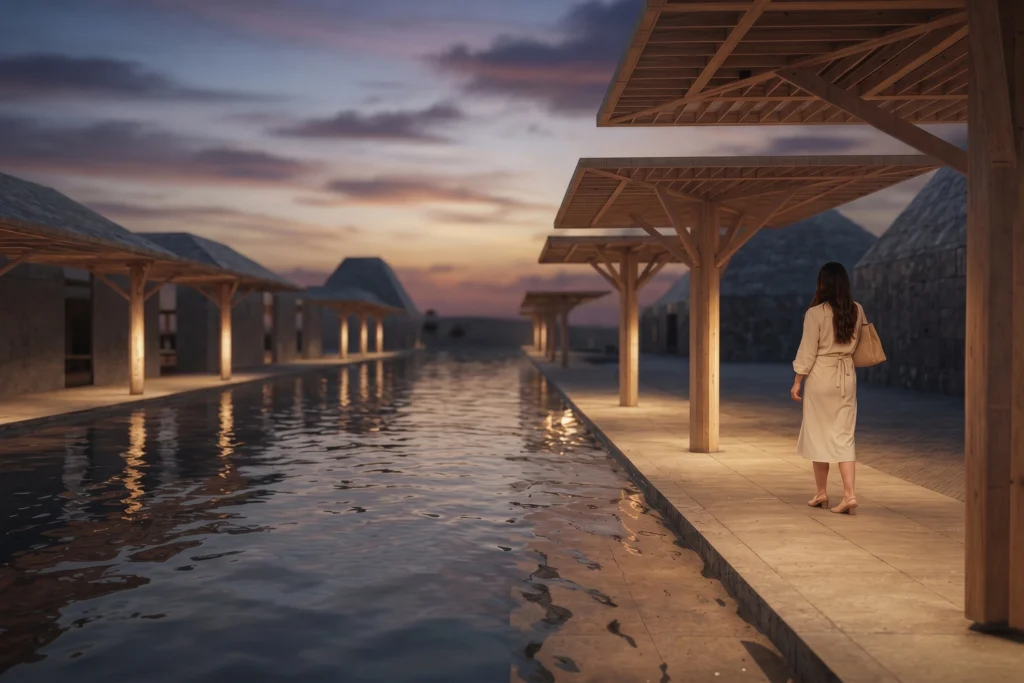
As evening falls, the canopy becomes a quiet framework for light, guiding movement and creating an atmosphere of warmth, comfort, and belonging.
Conventional solar carports
In urban settings, solar carports offer a practical solution for energy generation while providing shade for vehicles. However, their design often follows a predictable pattern: elongated pergola-like structures with a uniform dark canopy that casts extensive and regular shadow patterns. While efficient, these structures can dominate the landscape rather than integrating seamlessly with it.
Away from the ordinary
At ALTA LUMA, we believe that outdoor shading should be more than just functional, it should elevate the experience of the space. By rethinking how canopies interact with daylight, we create solutions that offer shade without compromising the beauty of natural light. Our designs embrace variation, blending into diverse settings while enhancing both aesthetics and solar energy efficiency.
Outdoor spaces should be as unique as their surroundings. By moving beyond standardized shading solutions, we unlock the potential for more distinctive, dynamic, and immersive environments – ones that celebrate light, shadow, and architectural harmony.