
Why Most Shading Solutions Fail Architectural Projects
Shading is often treated as a secondary element in architectural projects, a functional addition introduced late in the design process. However, this approach frequently leads to compromises that affect both the visual coherence and the spatial quality of the project.
In many cases, shading solutions do not fail technically, they fail architecturally.
Conventional Shading Solutions
Most shading systems available on the market are designed as standalone products. They are standardized, repetitive, and rarely adapted to the specific conditions of a project.
As a result, architects are often forced to choose between:
- Maintaining the integrity of the design
- Or introducing a solution that solves a functional problem but disrupts the overall composition
Pergolas, parasols, and other outdoor structures are typically added after the main architectural concept has been defined. This creates a disconnection between the built space and the elements meant to improve comfort.
When shading is not integrated from the beginning, it tends to appear as an external layer rather than part of the architecture itself.
This leads to several issues:
- Visual fragmentation of the space
- Inconsistent material language
- Disproportion between structure and surroundings
- Overly heavy or visually intrusive elements
Instead of reinforcing the project, the shading solution competes with it. For architects working on high-end residential, hospitality, or cultural projects, this is a critical limitation.
Another key limitation is the lack of adaptability.
Standard solutions are designed to fit many contexts, which means they are not truly suited to a specific project or site.
They do not respond to:
- Orientation and sunlight conditions
- Landscape and surroundings
- Intended use of the space
- Desired spatial experience
In practice, this results in outdoor areas that feel generic and disconnected from the overall concept of the project. For architects aiming to create unique and site-specific environments, this becomes a significant constraint. This creates tension between sustainability goals and aesthetic quality.
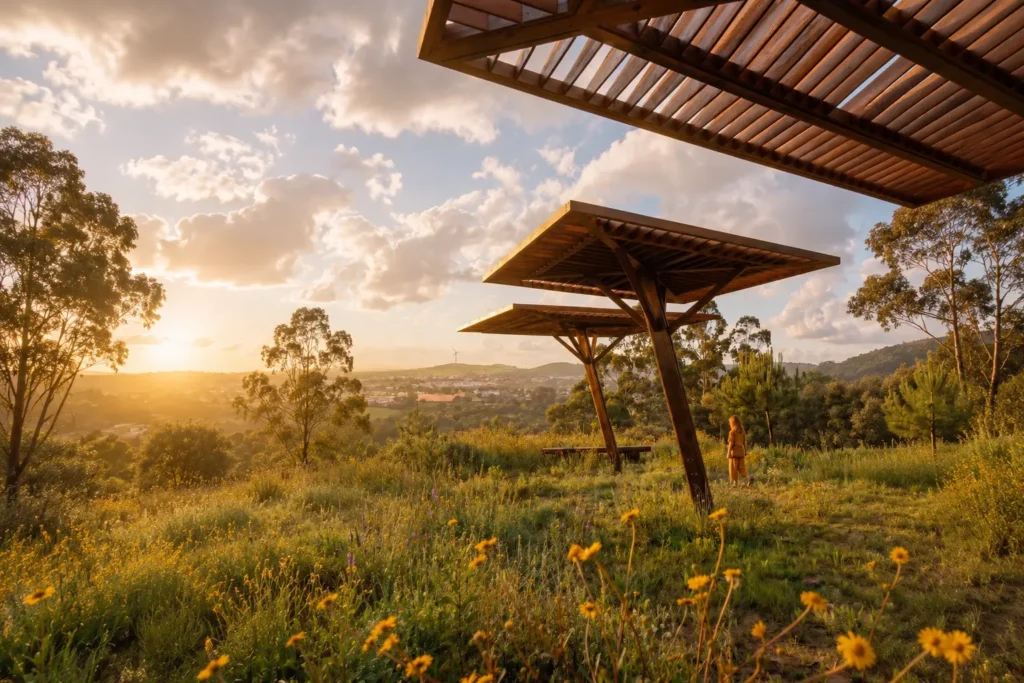
The Missing Spatial Experience
Traditional shading solutions are primarily designed to block sunlight. While effective in reducing heat and glare, this approach often results in:
- Overly enclosed spaces
- Loss of natural light quality
- Reduced connection to the surrounding environment
In many cases, the space becomes less comfortable in a broader sense not because of temperature, but because of the loss of openness and atmosphere.
Shading should not only provide protection, it should contribute to the experience of the space.
ALTA LUMA Approach
ALTA LUMA addresses these challenges by developing shading systems that are conceived as part of the architecture, not as an addition.
Key principles include:
- Customizable structures adapted to each project
- Light-filtering canopies that maintain openness
- A balance between comfort, performance, and spatial quality
Rather than creating isolated objects, the goal is to define spaces where shade, light, and structure work together. Most shading solutions fail architectural projects not because they lack functionality, but because they are not designed with architecture in mind. They are added too late, too standardized, and too disconnected from the spatial intent of the project.
For architects, the challenge is not simply to provide shade, but to do so in a way that enhances the space. When shading is approached as part of the architecture, it becomes more than a solution, it becomes a defining element of the project itself.